








Key points
- Temporary hearing changes and tinnitus can both occur after loud-noise exposure.
- It may take up to 48 hours to recover from temporary threshold shift.
- An audiogram can show a change in hearing thresholds. Book a free hearing test if you are concerned about your hearing.
Have you ever left a concert and noticed that everything sounded quieter, voices seemed muffled, or maybe you had to turn up the car radio to hear?
This change in your hearing may be a temporary threshold shift. It can happen after exposure to loud sound sources.
Your hearing may gradually return to normal. However, repeated episodes should not be ignored.
Understanding the signs, possible recovery time and when to get your hearing checked can help you protect your hearing over time.
What causes a temporary threshold shift?
Exposure to loud sound is the common cause of a temporary threshold shift. Noise may come from concerts, festivals, machinery, construction equipment, sporting events, power tools and some recreational activities.
The volume, duration and frequency of the exposure matter. And a temporary change does not mean that no damage occurred.
Temporary threshold shift after loud-sound exposure may indicate that some sensory hair cells in your inner ear are damaged. Repeated exposure can have a cumulative effect.
What are the symptoms?
A temporary threshold shift may feel different from one person to another.
Possible symptoms include:
- Temporarily reduced hearing
- Sounds that seem quieter or muffled
- More difficulty following speech than usual
- Ringing or buzzing in the ears
- A feeling of fullness in the ears
Do not assume that a sudden or significant hearing change is temporary. Contact a hearing care professional for an assessment.
How long can a temporary threshold shift last?
Recovery time varies. The Canadian Centre for Occupational Health and Safety states that hearing may gradually recover in a quiet environment. Complete recovery can take up to 48 hours.
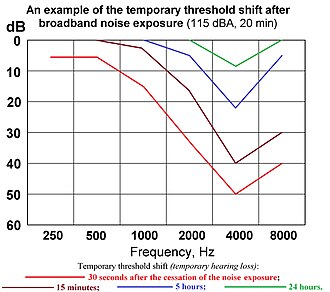
Recovery may depend on the intensity of the noise and the degree of the initial hearing change. During this time, avoid additional loud-noise exposure where possible.
If your hearing is not returning to normal, do not continue waiting on the assumption that the change is temporary. Have your hearing assessed.
A permanent threshold shift may develop as noise exposure continues over months or years. When noise-induced damage becomes permanent, hearing sensitivity does not improve after the exposure stops.
Temporary threshold shift and tinnitus
Temporary threshold shift and tinnitus can occur together. Loud noise often triggers tinnitus.
However, you can still experience tinnitus without a diagnosed hearing issue.
Prevention
There is no treatment that instantly restores hearing after a temporary threshold shift. Move away from loud noise and spend time in a quieter environment while your hearing recovers.
The best way to prevent a temporary threshold shift is to protect your hearing when sound levels are high:
- Turn down the volume when listening to music or other audio
- Limit the time you spend around loud sounds
- Move farther away from loud sound sources when possible
- Wear properly fitted earplugs or earmuffs in noisy environments
Consider a hearing assessment if you notice a change after loud-noise exposure, especially if it is not resolving.
A hearing assessment can show how you hear across different frequencies. Assessments over time may also make changes easier to identify.
At HearingLife, our hearing care professionals can assess your hearing, explain your results and discuss next steps that may be appropriate for you. There is no doctor referral required.
Book your complimentary hearing assessment today.
References
Health Canada, Government of Canada. Noise and sound: Hearing loss and tinnitus. https://www.canada.ca/en/health-canada/services/noise-your-health/hearing-loss-tinnitus.html
Health Canada, Government of Canada. Noise and sound: Protect your hearing health. https://www.canada.ca/en/health-canada/services/noise-your-health/protect-hearing-health.html
Canadian Centre for Occupational Health and Safety. Noise: Auditory effects. https://www.ccohs.ca/oshanswers/phys_agents/noise/noise_auditory.pdf
Veterans Affairs Canada. Hearing loss: Entitlement eligibility guideline. https://www.veterans.gc.ca/en/mental-and-physical-health/mental-health-and-wellness/compensation-illness-or-injury/disability-benefits/entitlement-eligibility-guidelines/az-index/hearing-loss
Infrastructure Health and Safety Association. Hearing protection, Construction Health and Safety Manual. https://www.ihsa.ca/rtf/health_safety_manual/pdfs/equipment/hearing_protection.pdf